
And why most GEO advice starts too late in the process.
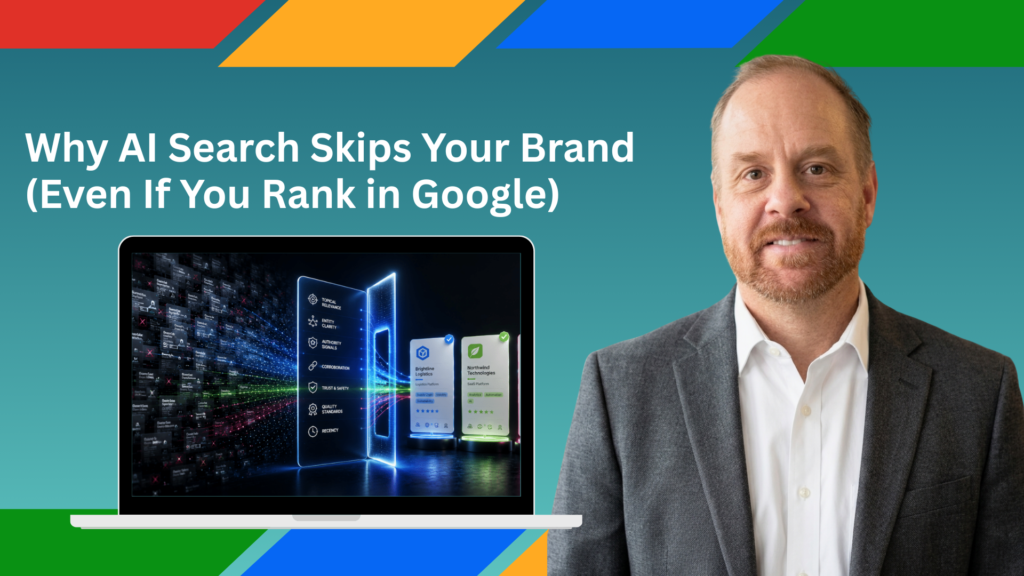
By now, most marketers have heard the same advice about AI visibility:
- Add schema.
- Structure your content.
- Build authority.
- Make your pages easy for LLMs to extract and cite.
All of that matters.
But there’s a problem: most brands are optimizing for AI citation before they’ve even qualified to be considered in the first place.
That’s the invisible layer most GEO conversations are missing.
As AI-generated search becomes more influential across platforms like ChatGPT, Perplexity, and Google Search, visibility is no longer just about ranking pages. AI systems are selecting entities.
And that changes everything.
The Shift from Pages to Entities
Traditional SEO was built around pages and rankings.
If your page ranked well for a keyword, you earned visibility.
AI systems work differently.
Instead of simply ranking pages, they:
- identify entities,
- evaluate relationships,
- filter candidates,
- and then select which brands deserve inclusion in the final answer.
That means a company can rank highly in Google and still fail to appear in AI-generated recommendations for the same query.
Why?
Because the page may rank — but the entity behind it may still be unclear, weakly associated with the topic, or insufficiently validated across the web.
This is the shift many brands haven’t fully processed yet:
In AI search, the unit of competition is no longer the page. It’s the entity.
The Two Thresholds of AI Visibility
AI recommendation systems generally operate through two distinct stages:
1. Qualification
This determines whether your brand is even eligible to enter the candidate set.
2. Selection
This determines whether your brand is actually recommended in the final answer.
Most GEO advice focuses only on selection.
But if you fail qualification, nothing else matters.
Qualification: Can AI Clearly Understand Who You Are?
At the qualification stage, AI systems are asking two core questions:
- Can this entity be clearly identified?
- Is this entity strongly associated with the topic?
If your brand identity is inconsistent, vague, or fragmented across the web, AI systems struggle to confidently connect all the signals together.
That creates ambiguity.
And ambiguity kills inclusion.
Clarity: Are You Distinct and Consistent?
One of the biggest AI visibility failures is simple inconsistency.
Different brand names.
Different descriptions.
Different positioning.
Different versions of the company identity scattered across the web.
Humans can usually figure it out.
Machines struggle.
AI systems rely heavily on signal consolidation. If your business appears under multiple variations, or your messaging changes from platform to platform, the system has to reconcile conflicting identities.
That weakens confidence.
The fix is often surprisingly simple:
- Use one canonical brand name everywhere.
- Keep descriptions consistent.
- Align your website, LinkedIn, directory listings, author bios, and social profiles.
- Reduce ambiguity wherever possible.
This isn’t glamorous work.
But it’s foundational.
Relevance: Does the Web Associate You with Your Topic?
Qualification also depends on topical association.
AI systems aren’t just asking:
“Do you have a page about this topic?”
They’re asking:
“Does the broader web consistently associate your brand with this subject?”
That distinction matters.
Relevance comes from:
- topic clustering,
- consistent mentions,
- contextual relationships,
- specialized expertise,
- and proximity to recognized entities in your industry.
Brands dilute themselves when they try to “rank for everything.”
The result is scattered authority instead of strong association.
In AI search, topical depth matters more than topical breadth.
Selection: Can AI Confidently Recommend You?
Once a brand passes qualification, the next phase begins.
Now the system evaluates:
- credibility,
- corroboration,
- and extractability.
This is where most current GEO advice finally becomes relevant.
Credibility: Do Independent Sources Validate You?
Your website can say anything about your business.
AI systems want confirmation from outside sources.
That’s why credibility signals are becoming increasingly important:
- press mentions,
- podcast appearances,
- awards,
- interviews,
- analyst coverage,
- citations,
- reviews,
- and industry references.
One of the most overlooked AI visibility assets right now is podcasts.
Why?
Because many podcasts generate transcripts.
Those transcripts become indexable web content that repeatedly associates:
- your name,
- your company,
- and your expertise
in an independent context.
That creates corroboration.
And corroboration strengthens selection.
Extractability: Can AI Easily Use Your Content?
Even qualified and credible brands can lose visibility if their content is difficult for AI systems to process.
A lot of branded content is still written primarily for human engagement:
- long introductions,
- buried answers,
- vague positioning,
- dense paragraphs,
- and excessive context dependency.
LLMs struggle with that format.
AI systems prefer content that is:
- direct,
- structured,
- self-contained,
- and easy to lift into generated responses.
Some practical fixes:
- Put answers first.
- Use clean heading structures.
- Write concise paragraphs.
- Make statements understandable outside the article context.
A simple test:
If a sentence could appear independently inside an AI-generated answer and still make sense, it’s extractable.
Recognition Isn’t Recommendation
This is where many brands misunderstand their current position.
AI may recognize your brand without recommending it.
There’s a major difference between:
- “AI knows you exist”
and - “AI trusts you enough to suggest you.”
You can test this yourself.
Ask:
- “What is [your brand]?”
- “What does [your brand] do?”
- “Who are the best [category] providers for [customer type]?”
The answers reveal where your visibility problem actually exists.
If AI struggles with Questions 1 and 2:
You have a qualification problem.
If AI answers 1 and 2 correctly but excludes you from 3:
You have a selection problem.
That distinction matters because the solutions are completely different.
Most Brands Are Optimizing in the Wrong Order
A common GEO workflow looks like this:
- Add schema
- Build FAQ content
- Improve extractability
- Earn mentions
But this assumes the AI system already clearly understands who you are.
Often, it doesn’t.
The proper sequence is:
Clarity → Relevance → Credibility → Extractability
The first two determine qualification.
The second two determine selection.
Without qualification, selection tactics compound very slowly — if at all.
The Highest-Leverage Starting Points
If your brand is struggling to appear in AI-generated recommendations, the highest ROI improvements are often the least technical.
1. Standardize Your Brand Identity
Use one consistent name and description everywhere online.
2. Rewrite Your About Page
Treat it like a machine-readable fact sheet:
- who you are,
- what you do,
- who you serve,
- where you operate,
- and what makes you distinct.
3. Strengthen Entity Structure
Implement organization schema and connect authoritative profiles using sameAs references.
These aren’t flashy tactics.
But they establish the foundation AI systems need before recommendation becomes possible.
The Future of AI Visibility Belongs to Qualified Entities
As AI systems mature, they’re becoming:
- more selective,
- more conservative,
- and more dependent on corroborated signals.
Publishing endless content alone won’t guarantee visibility anymore.
Brands that win in AI search will be the ones that are:
- clearly defined,
- consistently referenced,
- externally validated,
- and structurally easy for machines to understand.
The future of search visibility isn’t just about content production.
It’s about entity qualification.
And many brands are still optimizing as if that shift never happened.