
Not long ago, the most valuable marketers were experts in channels.
The SEO specialist knew search.
The PPC manager knew Google Ads.
The email marketer knew automation.
The social media manager understood engagement.
Those skills are still important—but they’re no longer enough.
The highest-performing marketing teams are beginning to look less like traditional marketing departments and more like engineering organizations.
Not because marketers suddenly need computer science degrees.
Because modern marketing is becoming a system-building discipline.
Marketing Has Become Too Complex for Manual Execution
Today’s marketing teams manage hundreds of moving parts:
- Multiple advertising platforms
- CRM systems
- Customer data platforms
- Analytics tools
- AI applications
- Marketing automation
- Attribution models
- Content workflows
- Personalization engines
Each platform generates data.
Each platform influences the others.
Managing all of this manually simply doesn’t scale.
That’s why the conversation is shifting from campaign execution to system design.
Engineers Build Systems
Software engineers don’t solve the same problem every day.
They build systems that solve the problem repeatedly.
Marketing is moving in the same direction.
Instead of asking:
“How do I optimize this campaign?”
We’re beginning to ask:
“How do I build a system that continuously optimizes every campaign?”
That’s a fundamentally different mindset.
AI Changes the Role of the Marketer
Generative AI has already accelerated content creation.
But the next wave is operational.
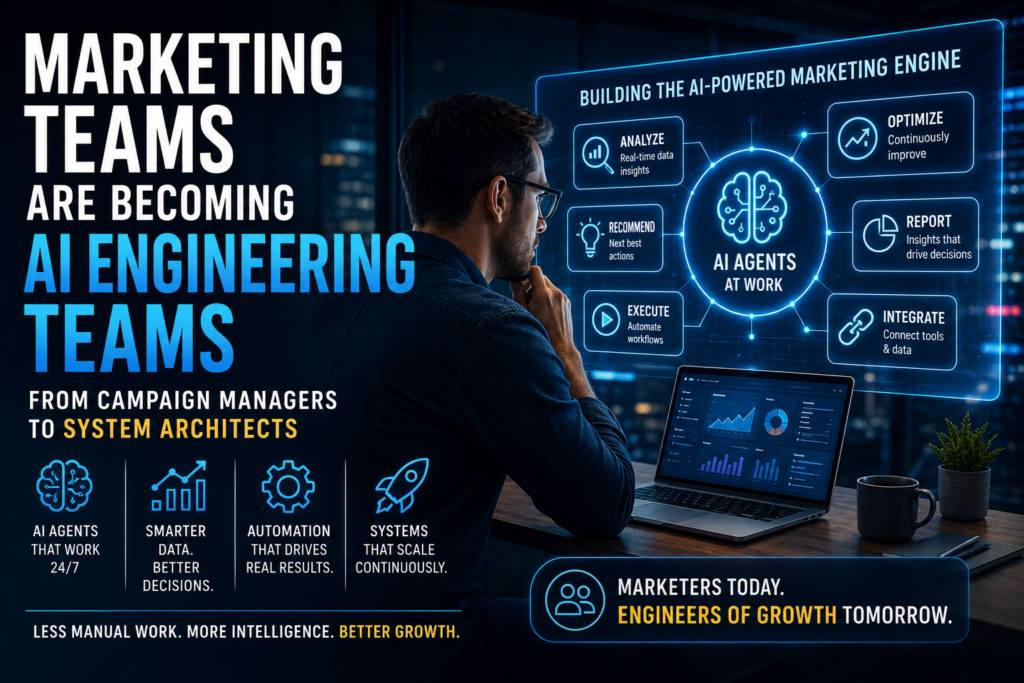
AI agents can monitor campaigns, analyze data, identify opportunities, recommend actions, generate reports, and even execute approved workflows.
The marketer’s role becomes one of orchestration rather than execution.
Instead of spending hours pulling reports, they’re designing intelligent systems that deliver insights automatically.
The New Competitive Advantage
Winning organizations won’t necessarily have the biggest marketing budgets.
They’ll have the smartest marketing infrastructure.
They’ll connect APIs instead of copying spreadsheets.
They’ll deploy AI agents instead of adding repetitive manual work.
They’ll build feedback loops that improve continuously rather than relying on quarterly optimizations.
That’s engineering thinking applied to marketing.
What This Means for Marketing Leaders
The future CMO won’t just oversee campaigns.
They’ll oversee systems.
Their responsibilities will increasingly include:
- AI governance
- Workflow architecture
- Data integration
- Agent orchestration
- Automation strategy
- Performance intelligence
Marketing is evolving from managing channels to managing intelligent ecosystems.
Final Thoughts
Marketing isn’t losing its creativity.
It’s gaining a technical foundation.
Creativity will always differentiate brands.
But increasingly, success will depend on the systems that deliver the right message, to the right audience, at the right time—and improve themselves every day.
The best marketing teams of the next decade won’t simply use AI.
They’ll engineer marketing organizations that learn, adapt, and grow faster than their competitors.
That’s the future I’m excited to build.