
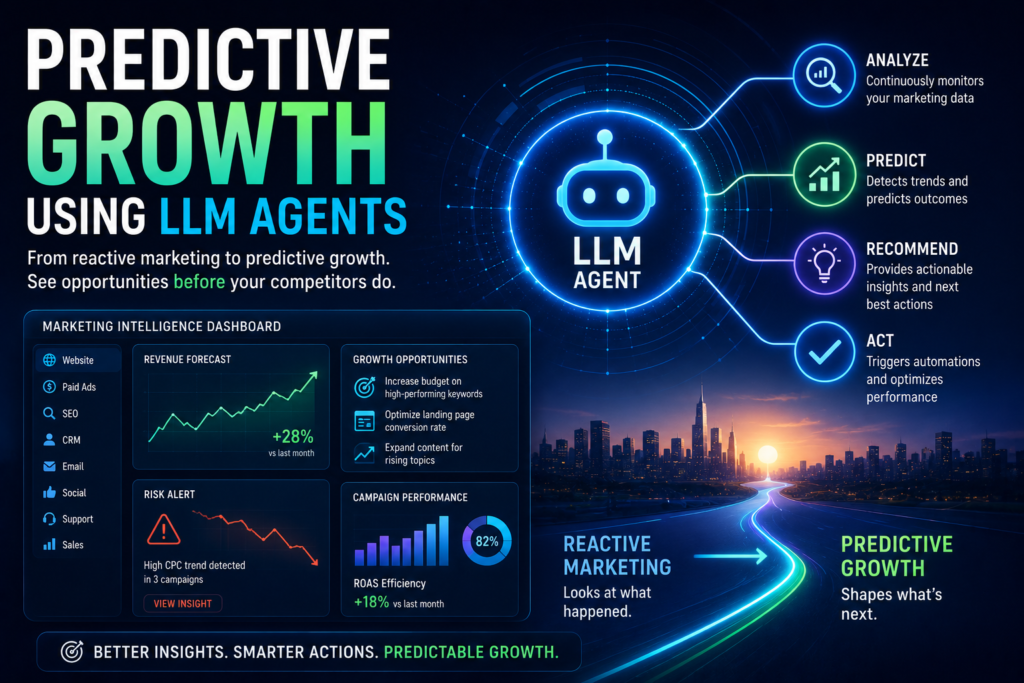
Marketing has always been reactive.
A campaign launches.
Data comes in.
Reports are generated.
The team analyzes performance.
Optimizations are made.
Then the cycle starts over again.
For decades, that’s been the standard operating model.
But what if your marketing organization could identify opportunities—or problems—before they happened?
That’s where Large Language Model (LLM) agents are beginning to change the game.
We’re moving from reactive marketing to predictive growth.
Why Traditional Marketing Is Always Looking in the Rearview Mirror
Most marketing decisions rely on historical data.
Last month’s ROAS.
Last week’s conversion rate.
Yesterday’s traffic.
Quarterly pipeline.
These metrics are essential, but they only tell us what has already happened.
By the time a report identifies declining performance, the opportunity to prevent it has often passed.
Imagine driving a car while only looking through the rearview mirror.
Eventually, you’ll crash.
Marketing isn’t much different.
LLM Agents Add Context—Not Just Data
Traditional analytics platforms are excellent at measuring performance.
What they don’t do well is explain why something is happening or what should happen next.
LLM agents bridge that gap.
Instead of simply reporting numbers, they can analyze multiple data sources simultaneously, understand relationships between them, identify emerging patterns, and recommend actions before issues become costly.
Think of them as always-on marketing analysts that never stop looking for opportunities.
Predictive Growth Starts With Connected Data
An LLM agent becomes exponentially more valuable when it has access to multiple systems.
Imagine connecting it to:
- Google Analytics
- Google Ads
- Meta Ads
- Search Console
- CRM data
- Sales pipeline
- Email marketing
- Website behavior
- Customer support trends
- Competitive intelligence
- Industry news
- Seasonal performance history
Individually, each platform provides information.
Together, they provide context.
That’s where prediction becomes possible.
A Practical Example
Imagine an AI growth agent notices several subtle signals over the course of a week:
Organic traffic begins slowing for high-intent keywords.
Paid search competition increases.
Landing page engagement declines.
Sales-qualified leads drop slightly.
Customer support questions about pricing increase.
None of these signals alone would necessarily trigger concern.
Together, they indicate something larger may be developing.
Instead of waiting until monthly reporting reveals a significant decline, the LLM agent identifies the pattern early, explains the likely causes, estimates the potential business impact, and recommends immediate actions.
That’s predictive growth.
Growth Agents Never Stop Learning
Unlike static dashboards, LLM agents continuously refine their understanding.
Over time they learn:
- Seasonal trends
- Campaign performance patterns
- Customer behavior
- Channel effectiveness
- Sales cycles
- Content performance
- Budget efficiency
- Competitive dynamics
The more context they accumulate, the better their recommendations become.
They’re not simply collecting data.
They’re building institutional knowledge.
From Reporting to Recommendation
Most marketing reports answer one question:
“What happened?”
Predictive LLM agents answer three:
- What is happening?
- Why is it happening?
- What should we do next?
That’s a much more valuable conversation for marketing leaders.
The Future Growth Team
I believe every high-performing marketing organization will eventually have specialized AI growth agents responsible for different areas of the business.
For example:
Performance Agent
- Detects campaign inefficiencies
- Forecasts budget requirements
- Identifies optimization opportunities
SEO Agent
- Predicts ranking volatility
- Monitors AI search visibility
- Identifies emerging content opportunities
Revenue Agent
- Connects marketing activity to pipeline and revenue
- Forecasts lead quality
- Detects conversion bottlenecks
Customer Intelligence Agent
- Monitors reviews, surveys, and support conversations
- Identifies changing customer sentiment
- Surfaces unmet needs
Together, these agents create a marketing organization that is constantly learning.
Human Judgment Becomes Even More Valuable
Prediction doesn’t eliminate the need for marketers.
It amplifies them.
AI can identify patterns.
Humans provide business context.
AI recommends.
Humans prioritize.
AI analyzes.
Humans decide.
The strongest organizations will combine intelligent systems with experienced leadership.
Building Toward Predictive Marketing
You don’t need an enterprise AI platform to begin.
Start by asking a simple question:
“If an AI agent monitored this process every hour, what problems could it identify before we would?”
Maybe it’s:
- Paid media performance
- Organic search trends
- Lead quality
- Customer churn
- Email engagement
- Website conversions
- Revenue forecasting
Solve one problem exceptionally well.
Then expand.
Over time, those individual agents become a predictive growth engine.
Final Thoughts
The future of marketing won’t belong to the organizations with the most dashboards.
It will belong to the organizations that recognize meaningful patterns before anyone else.
LLM agents make that possible.
They transform disconnected marketing data into connected business intelligence.
They help teams shift from reacting to predicting, from reporting to recommending, and from optimization to continuous improvement.
The marketers who embrace predictive growth won’t just make better decisions.
They’ll make them sooner.
And in today’s competitive landscape, that timing advantage may be the biggest advantage of all.