
At MozCon in NYC, I found myself in a conversation that felt like a time warp — standing with Dr. Pete Meyers, talking about Google Hummingbird. Yes… Hummingbird. In 2025.
And honestly?
It was wild.

Because hearing Hummingbird come up again reminded me just how far ahead Google was over a decade ago — and how clearly the breadcrumbs pointed to the world we’re operating in today with LLMs, generative search, and AI-driven context understanding.
Back in 2013, I wrote an article for Search Engine Journal titled “Hummingbird Pivot and Context Identifiers”
And revisiting that piece now, in the middle of the AI revolution, hits a little differently.
Hummingbird Was the First Real Turning Point
In 2013, most SEOs saw Hummingbird as a mild update. But it was actually the quiet beginning of something much bigger:
- Understanding meaning over keywords
- Interpreting intent instead of literal strings
- Handling natural language and conversational queries
- Building infrastructure for entity-based indexing
- Preparing for semantic relationships between concepts
Even in my SEJ article, I described it as a “perfect storm” — a set of signals, patents, behaviors, and search shifts that didn’t quite make sense on their own… but clearly pointed toward something structural.
And now, in 2025, we’re living inside what Hummingbird made possible.
Generative search, multi-turn query understanding, LLM-enhanced ranking layers — all of it traces back to Google’s quiet pivot toward meaning, context, and relationships.
My Favorite Memory From MozCon NYC: Talking Semantic Search with Dr. Pete
I’ve been in the SEO industry long enough to know how rare it is to cross paths with people who lived the same eras you did — the Panda days, the Knowledge Graph rollout, the emergence of entity search, the schema experiments… all of it.
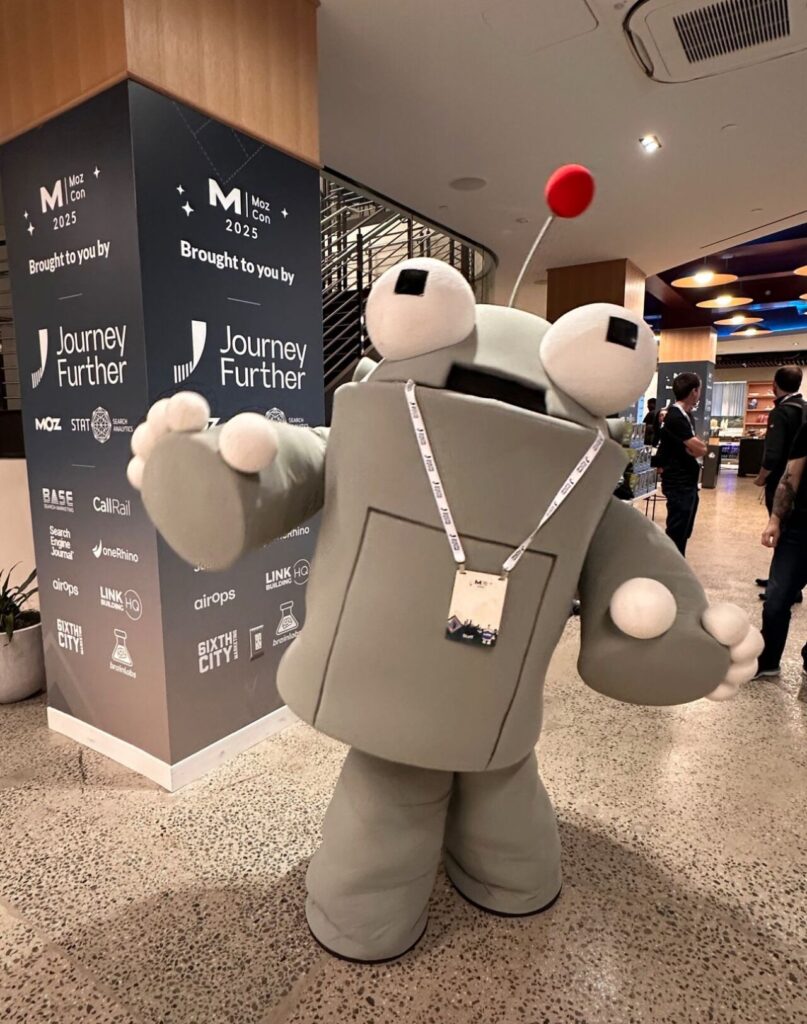
Catching up with Dr. Pete at the Moz Con conference reminded me how important these long-term perspectives are. Very few people have watched the industry shift like us dinosaurs.
My Early Adoption of Semantic SEO (Before It Was Cool)
One thing I’ve always been proud of is how early I leaned into semantic SEO and entity optimization. As a brand ambassador with Majestic, I have spent over a decade exploring:
- entity relationships
- topic mapping
- contextual windows
- inverse document frequency
- semantic link analysis
- topic clusters before they had a name
- and the early “entity-based search” thinking that wasn’t mainstream yet
Majestic’s visualization graphs, trust and citation flows, and topical mapping tools were some of the earliest real-world hints that SEO was moving past keywords, past simple links, and into meaning.
Today, entity SEO is everywhere:
- site architecture
- schema strategies
- topical authority
- content clustering
- E-E-A-T signals
- semantic internal linking
- knowledge graph enhancements
Back then, we were hacking together tools, spreadsheets, and Majestic graphs trying to prove why this mattered.
Now it is the industry.

Why Hummingbird Still Matters in 2026 and Beyond
Looking back, Hummingbird wasn’t just an algorithm update. It was the start of a new philosophy of search. A philosophy that led directly to:
- BERT
- MUM
- SGE / AI Overviews
- LLM-powered ranking augmentations
- conversational, multi-turn search
- query rewriting using transformers
- deeper entity relationships
- contextual weighting over keywords
In 2013, we called it semantic search.
In 2025, it’s just called search.
Final Thoughts from MozCon 2025
Standing in NYC with Dr. Pete Myers – both of us still in the game, still fascinated by the evolution of search — reminded me why I love this industry. We’ve gone from:
- keyword density
- to semantic relationships
- to entity optimization
- to machine learning
- to transformer-based reasoning
- to full multimodal LLM-driven search
And Hummingbird was the first breadcrumb.
As I said at the MOZ CON conference: “Google was already building LLM-era infrastructure before any of us realized it.”
If you want to read the original article that kicked off this reflection, here it is again:
Hummingbird Pivot and Context Identifiers (2013)
A decade later, everything I saw happening then has become the foundation of what we’re optimizing for now.
And honestly?
It feels pretty damn good to still be here for it.