
Artificial intelligence is rapidly changing marketing, but most organizations are still using it the same way they used previous technologies—as a faster tool for completing manual work.
They use AI to write emails, generate ad copy, summarize reports, or brainstorm campaign ideas.
Those are valuable use cases, but they barely scratch the surface.
The real transformation begins when AI stops acting like software and starts acting like a team member.
This is the foundation of Agentic Marketing.
Instead of asking, “How can AI help me do this task?” the better question is:
“How can AI own this process from beginning to end?”
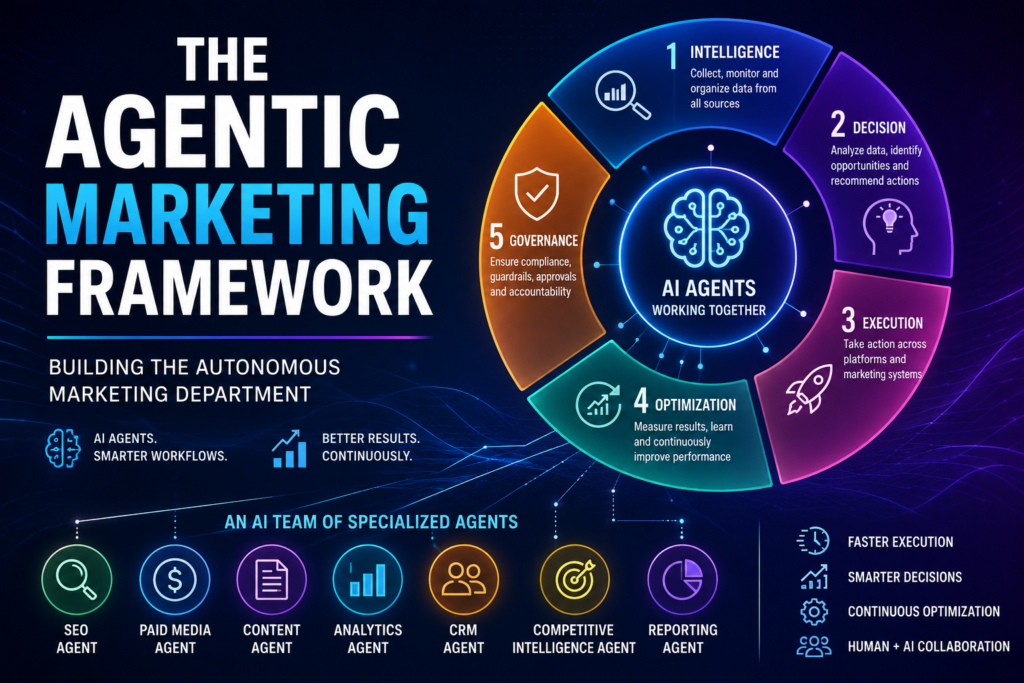
That’s the mindset behind the Agentic Marketing Framework.
What Is Agentic Marketing?
Agentic Marketing is an operating model where specialized AI agents collaborate with human marketers to continuously monitor, analyze, optimize, and execute marketing operations.
Unlike traditional automation, which follows predefined rules, AI agents pursue objectives.
They can:
- Analyze data
- Reason through problems
- Choose the next best action
- Execute workflows
- Learn from previous outcomes
- Collaborate with other AI agents
- Escalate decisions that require human approval
Rather than replacing marketers, they amplify them.
The goal isn’t fewer marketers.
The goal is exponentially more productive marketers.
The Five Layers of the Agentic Marketing Framework
Think of your marketing department as a company within your company.
Every team has responsibilities.
Every responsibility can be supported—or in many cases owned—by an AI agent.
Layer 1: Intelligence
Everything starts with information.
Intelligence agents continuously collect and organize data from:
- Google Analytics
- Google Ads
- Meta Ads
- CRM platforms
- Search Console
- SEO tools
- Competitive intelligence
- Customer reviews
- Social listening
- Industry news
- Internal documentation
Instead of waiting for someone to build reports, these agents monitor your business around the clock.
Their job isn’t reporting.
It’s awareness.
Layer 2: Decision
Data by itself creates noise.
Decision agents transform information into recommendations.
Examples include:
- Identifying declining campaigns
- Detecting attribution issues
- Finding wasted ad spend
- Predicting churn
- Prioritizing SEO opportunities
- Recommending budget reallocations
- Discovering content gaps
- Identifying CRO opportunities
Rather than producing dashboards, they answer one question:
“What should we do next?”
Layer 3: Execution
This is where AI becomes operational.
Execution agents perform work across marketing systems.
Examples include:
- Publishing content
- Launching campaigns
- Updating landing pages
- Writing ad variations
- Optimizing bids
- Managing CRM records
- Creating reports
- Building audience segments
- Submitting indexing requests
- Updating knowledge bases
Every action follows predefined guardrails and approval rules.
Execution becomes continuous instead of event-driven.
Layer 4: Optimization
Optimization never stops.
These agents constantly measure outcomes.
They ask questions like:
- Did conversion rate improve?
- Did CPA decrease?
- Did rankings increase?
- Did engagement improve?
- Did revenue increase?
If something isn’t working, they investigate why.
They compare historical performance, identify trends, generate new hypotheses, and recommend the next round of improvements.
Marketing becomes a continuous learning system.
Layer 5: Governance
No AI system should operate without oversight.
Governance agents ensure that every action aligns with:
- Brand guidelines
- Legal requirements
- Privacy policies
- Budget constraints
- Security standards
- Human approval workflows
- Audit logging
As AI capabilities expand, governance becomes just as important as automation.
The companies that succeed won’t simply build more AI.
They’ll build more trustworthy AI.
The Agent Team
Instead of one giant AI assistant, imagine building a department of specialists.
SEO Agent
- Monitors rankings
- Audits technical SEO
- Detects indexing issues
- Finds content opportunities
Paid Media Agent
- Watches campaign performance
- Identifies wasted spend
- Recommends optimizations
- Prepares campaign updates
Content Agent
- Researches topics
- Builds content briefs
- Writes first drafts
- Optimizes for AI search
- Refreshes existing content
Analytics Agent
- Monitors KPIs
- Detects anomalies
- Validates attribution
- Creates executive summaries
CRM Agent
- Scores leads
- Updates records
- Identifies lifecycle gaps
- Suggests nurture campaigns
Competitive Intelligence Agent
- Monitors competitors
- Tracks pricing
- Detects new campaigns
- Identifies emerging trends
Reporting Agent
- Produces dashboards
- Creates executive summaries
- Explains performance changes
- Recommends next actions
Each agent becomes an expert in a specific domain while collaborating with the others.
Human Marketers Become Orchestrators
As AI assumes more operational work, the marketer’s role evolves.
Instead of executing dozens of individual tasks, marketers focus on:
- Business strategy
- Customer insights
- Creative direction
- Brand storytelling
- Prioritization
- Cross-functional collaboration
- AI governance
- System design
The future marketer spends less time clicking buttons and more time designing systems that create results.
Why This Changes Everything
Traditional marketing teams grow by adding people.
Agentic marketing scales differently.
When workload doubles, you don’t necessarily hire another specialist.
You improve your agents.
You add another workflow.
You connect another API.
You expand your AI workforce.
This creates organizations that are:
- Faster
- More scalable
- More consistent
- More data-driven
- More responsive
- More cost-efficient
The competitive advantage shifts from headcount to intelligence.
Getting Started
You don’t need dozens of AI agents on day one.
Start with one.
Choose the most repetitive, time-consuming process in your marketing organization.
Examples include:
- Weekly reporting
- SEO audits
- PPC monitoring
- Content research
- Lead qualification
- Competitive analysis
Build an agent that performs that job exceptionally well.
Then build another.
Over time, those individual agents become an interconnected operating system for your marketing department.
That’s when the real transformation begins.
Final Thoughts
The next generation of marketing won’t be defined by who has the biggest budget or the largest team.
It will be defined by who builds the smartest systems.
The Agentic Marketing Framework isn’t about replacing marketers with artificial intelligence.
It’s about creating a partnership where humans provide vision, creativity, and strategy while AI delivers speed, consistency, analysis, and execution.
The organizations that embrace this model today won’t simply become more efficient.
They’ll build marketing departments that learn faster, adapt quicker, and outperform competitors in ways that traditional teams simply can’t match.
The future of marketing isn’t a single AI assistant sitting beside a marketer.
It’s an intelligent team of specialized AI agents working together—continuously, autonomously, and always aligned with your business goals.