
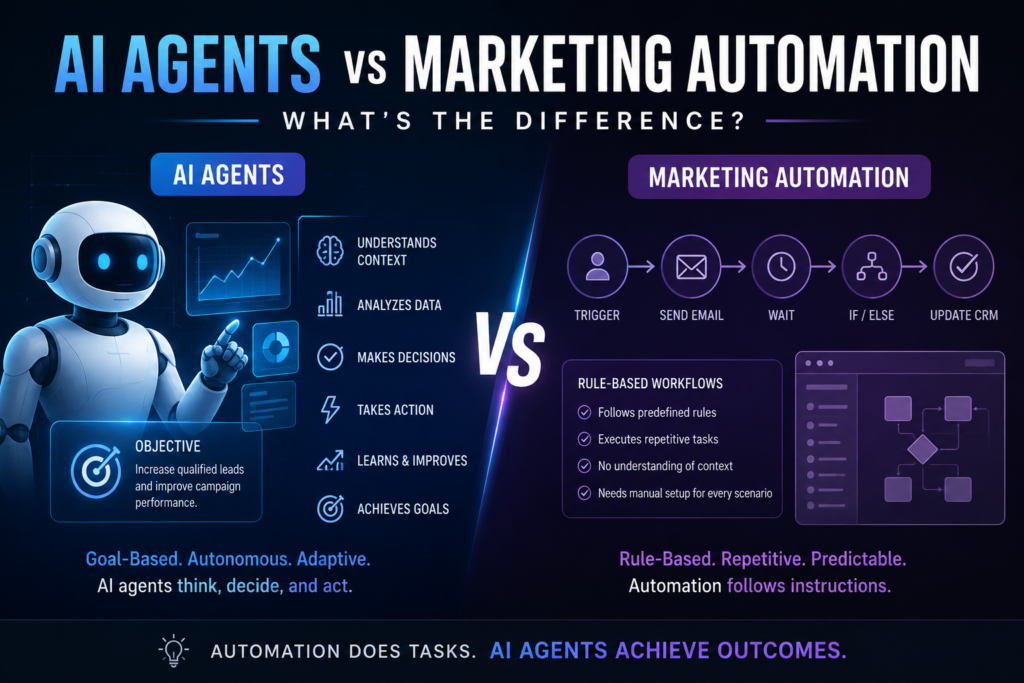
For years, marketing automation has been one of the biggest drivers of efficiency in digital marketing. Platforms like HubSpot, Marketo, Salesforce, Zapier, and Make have helped marketers automate repetitive tasks, nurture leads, send emails, and connect systems together.
But we’re entering a new era.
AI agents aren’t just another automation tool—they represent a fundamental shift in how marketing work gets done. Instead of simply executing predefined workflows, AI agents can analyze, reason, make decisions, and take action with minimal human intervention.
Understanding this distinction is becoming essential for every marketing leader.
What Is Traditional Marketing Automation?
Traditional marketing automation is built around rules.
A trigger occurs, and a predetermined action follows.
For example:
- A prospect downloads an ebook.
- They enter a nurture campaign.
- After three emails, they receive a product offer.
- If they click, they move into a sales sequence.
- If they don’t, they’re added to a re-engagement campaign.
Every step is designed in advance by a marketer.
The software doesn’t understand why someone behaved a certain way. It simply follows the instructions it was given.
Marketing automation excels at:
- Email nurturing
- CRM updates
- Lead routing
- Form processing
- Workflow orchestration
- Notification systems
- Data synchronization
It’s incredibly valuable—but it’s still fundamentally rule-based.
What Is an AI Agent?
An AI agent goes beyond automation.
Rather than following a fixed sequence of rules, an AI agent is given an objective.
Instead of telling it exactly what to do, you tell it what success looks like.
For example:
“Identify declining paid search campaigns, determine the likely cause, recommend optimizations, implement approved changes, document the results, and report performance improvements.”
The agent decides how to accomplish that goal.
It can:
- Analyze data
- Search documentation
- Review historical performance
- Compare competitors
- Generate hypotheses
- Write content
- Connect APIs
- Execute workflows
- Learn from previous outcomes
- Escalate when human approval is needed
That’s a completely different operating model.
Rule-Based vs. Goal-Based
Think about the difference between GPS navigation and a human driver.
Marketing automation is like driving with turn-by-turn directions.
If the road closes unexpectedly, the system struggles because it only knows the original route.
An AI agent behaves more like an experienced driver.
If traffic appears, construction blocks the road, or weather changes conditions, it adjusts the route while still reaching the destination.
The objective stays the same.
The path changes intelligently.
An Example
Imagine your cost per acquisition suddenly increases by 35%.
Traditional Automation
The system sends an alert.
Someone logs into Google Ads.
Someone exports reports.
Someone investigates.
Someone writes recommendations.
Someone makes changes.
Someone updates management.
Every step requires human effort.
AI Agent
The agent notices the increase automatically.
It analyzes:
- Campaign performance
- Search terms
- Auction insights
- Budget pacing
- Conversion trends
- Landing page performance
- Competitor activity
- Creative fatigue
- Historical seasonality
It identifies likely causes, prioritizes recommended actions, prepares changes for approval (or implements them within predefined guardrails), documents every decision, and delivers a concise executive summary.
The marketer shifts from doing the work to supervising the work.
Why This Matters
Marketing teams aren’t getting larger.
Budgets aren’t growing as quickly as expectations.
Every year, marketers are expected to manage:
- More channels
- More data
- More content
- More reporting
- More personalization
- Faster execution
AI agents allow one marketer to accomplish significantly more by taking ownership of repetitive analysis and execution.
They’re not replacing strategic thinking.
They’re removing operational bottlenecks.
AI Agents Can Work Together
The real power emerges when multiple agents collaborate.
Imagine a team of specialized AI workers.
An SEO agent monitors rankings and technical issues.
A paid media agent optimizes campaigns and budgets.
A content agent creates landing pages and ad copy.
An analytics agent validates attribution and identifies anomalies.
A competitive intelligence agent tracks industry changes.
A reporting agent summarizes performance for leadership.
Together, they create an always-on marketing operations team working continuously.
Human Judgment Still Matters
Despite rapid advances, AI agents shouldn’t operate without governance.
Experienced marketers still provide:
- Business strategy
- Brand positioning
- Budget priorities
- Ethical oversight
- Legal compliance
- Creative direction
- Customer understanding
The best organizations combine human expertise with AI execution.
Think of AI agents as highly capable teammates—not replacements for leadership.
The Skills Marketing Leaders Need Next
The most valuable marketers over the next five years may not be the best prompt writers.
They’ll be the best system designers.
That means learning how to:
- Define business objectives
- Design agent workflows
- Connect APIs and data sources
- Build approval processes
- Measure agent performance
- Optimize AI operations over time
Marketing is evolving from campaign management into systems engineering.
Final Thoughts
Marketing automation transformed how businesses executed repetitive tasks.
AI agents are transforming how marketing decisions are made and how work gets completed.
Automation answers the question:
“What should happen when this event occurs?”
AI agents answer a different question:
“What’s the best way to achieve this objective?”
That shift—from following instructions to pursuing goals—is what makes AI agents one of the most significant technological advances marketing has seen since the rise of digital advertising.
The marketers who embrace this change won’t simply work faster. They’ll build marketing organizations that are more adaptive, more intelligent, and more scalable than ever before.
The future of marketing isn’t just automated.
It’s autonomous.